How old is Snakes and Ladders? The evidence for “ancient” keeps coming apart
Nobody has produced a board, or a written mention of one, from earlier than the late eighteenth century. Several claims have been made that push the game further back, and over the past twenty years each of them has been examined and each has weakened rather than held. This is the story of what happened to them, one at a time.
The game we call Snakes and Ladders descends from the Indian gyan chaupar, also known as moksha patam and paramapada sopanam. That much is not in question. The question is when it began, and the popular answers — two thousand years, or a thirteenth-century saint — rest on specific pieces of evidence that can be looked up. So I looked them up.
The work below is not mine. It belongs to two scholars: Andrew Topsfield, formerly Keeper of Eastern Art at the Ashmolean Museum, who published the first critical studies of the surviving charts in 1985 and 2006, and Jacob Schmidt-Madsen, whose 2019 Copenhagen thesis catalogues the whole known corpus of nearly 150 charts. What makes the story worth telling is that several of the claims that came apart were Topsfield’s own, and it was he who first warned that some of the material could not be trusted.
The board that was the oldest known for thirty years
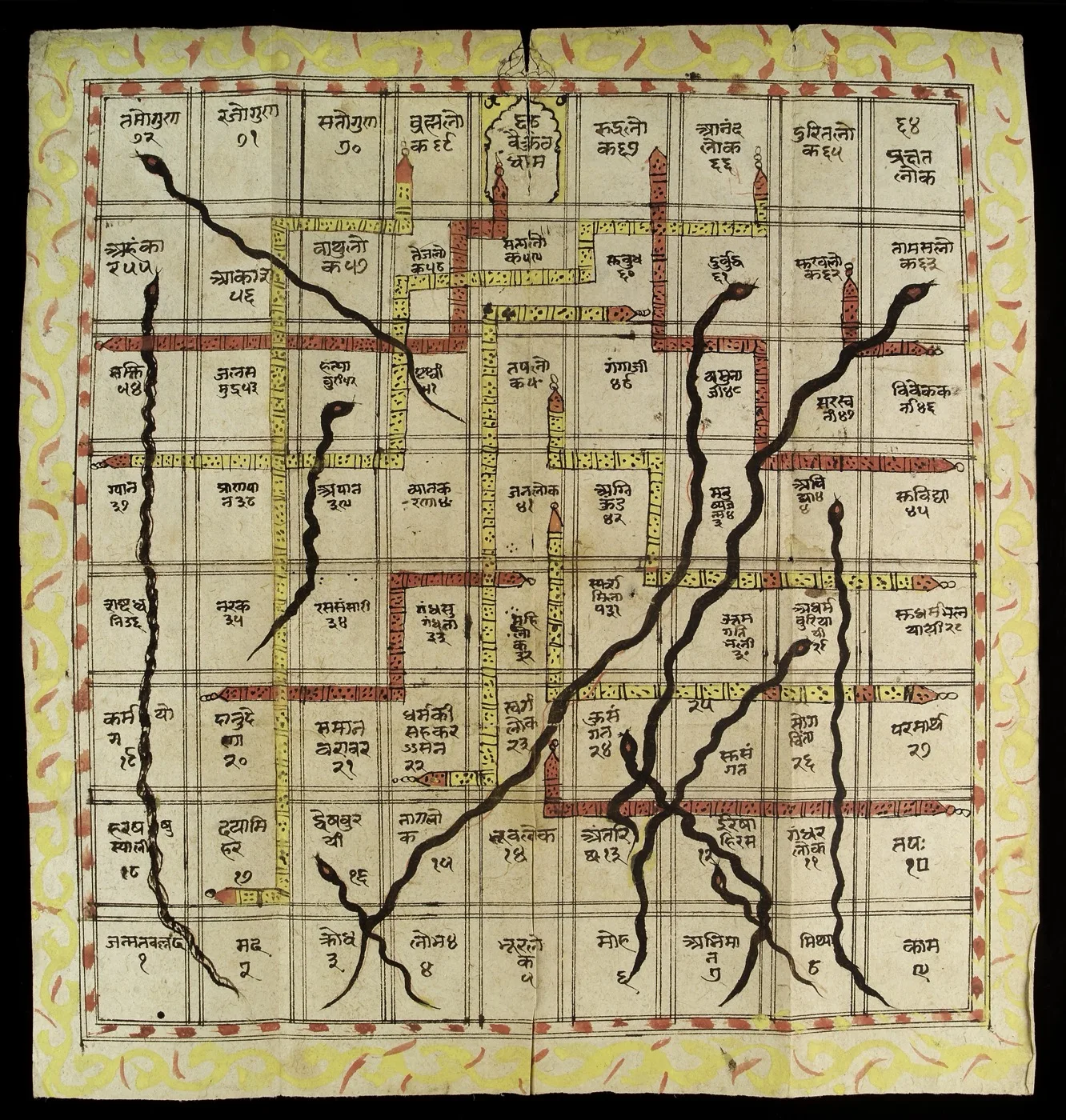
An 84-square Jain chart from Rajasthan carries a date corresponding to 1735 or 1736. Topsfield reported it in 1985, and for three decades it was treated as the earliest surviving example of the game.
It no longer is. A second chart turned up that resembles it closely but is obviously much later, and both share a detail that gave them away: the abrasion across the surface is uniform. A board that people actually played on wears unevenly, because some squares are handled far more than others. Even wear is what you get when someone ages a painting on purpose. Schmidt-Madsen writes that the 1735/36 chart “must now be regarded with skepticism” (vol. 1, p. 37), and describes forgery in this corpus as a phenomenon that “seems to have become more widespread in recent years” (p. 78).
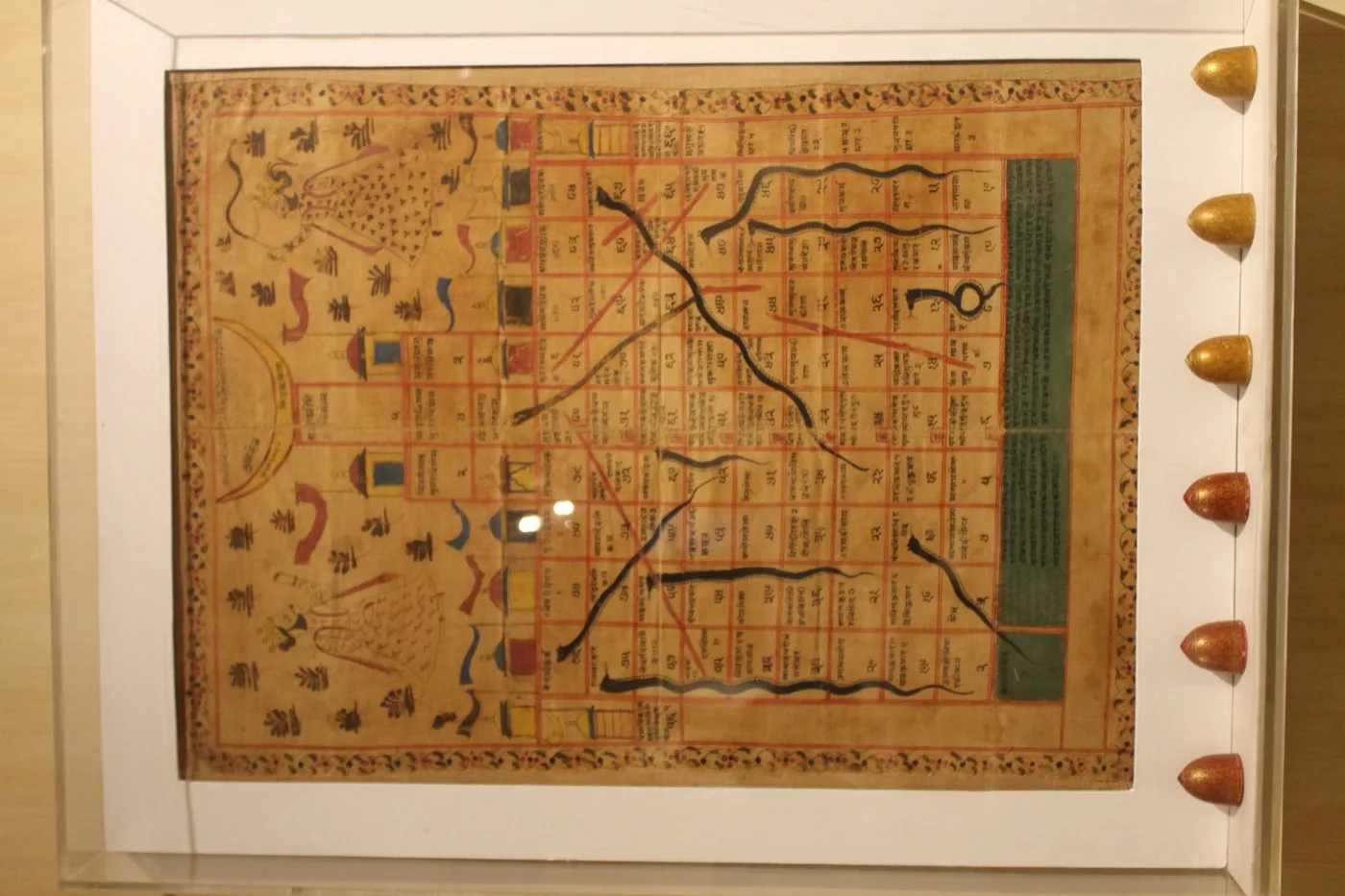
Topsfield saw it coming. In 2006 he had already flagged another Jain chart, painted in a late-fifteenth-century style, for anachronisms suggesting a far more recent hand.
The manuscript nobody has seen
The strongest claim for a medieval origin came from the late Rangachar Vasantha, who told Topsfield she had seen a Jain manuscript of the Mahanisihasutta, dated to the eleventh or twelfth century, containing a karmic diagram much like a gyan chaupar chart but without the snakes and ladders.
She never documented it. She never said where it was. And in a recorded lecture she gave at the Oxford Centre for Hindu Studies in 2004, she described what appears to be the same manuscript as being from the seventh century. By the time the account reached Topsfield the date had moved to the eleventh or twelfth. Vasantha died in 2011, and Schmidt-Madsen’s judgement is that it now seems unlikely the claim will ever be verified (p. 38).
His own guess is that what she saw was a grid diagram of the kind Jain manuscripts use to lay out doctrine — the Karmagrantha of the thirteenth century, for instance, is often accompanied by exactly such charts — rather than a playing board.
The argument from how good the early boards look
This one is subtler and more interesting, because it is an inference rather than an object. Topsfield observed that the earliest charts already show a fully developed maturity, and reasoned that a lengthy process of evolution over several centuries must lie behind them.
Schmidt-Madsen’s answer is that the whole design, including the rules, may have been borrowed from an existing game with very little change, in which case polish tells you nothing about how long the game had been played. And he turns the other standard argument around as well. It is often said that so few charts survive from before the nineteenth century because they were painted on cloth and paper, which perish. True enough — but the absence of any surviving example and any written reference before the late eighteenth century, he notes, could just as easily mean the game had not yet been invented (p. 37).
Three traditions, three thirteenth-century founders, no objects
The Marathi tradition attributes the game to the poet-saint Jnaneshvar, whose Jnaneshvari was completed in 1290. The Sufi version, shatranj al-arifin, is attributed to Ibn al-Arabi, who died in 1240. A nineteenth-century Tibetan chart of the related game sa lam rnam bzhag carries an inscription crediting Sakya Pandita, who died in 1251.
Three separate religious traditions, three founders from the same century, and from those centuries not one board and not one text that mentions a board. What that pattern shows is how a tradition confers authority on something it values. It is not how a date gets established.
What is actually left standing
- The earliest chart that can be dated with confidence is a 72-square Vaishnava board commissioned in Lucknow between 1780 and 1782 by Richard Johnson, Head Assistant to the Resident there and a collector whose manuscripts are now in the British Library.
- The earliest confirmed written mention comes half a century after that: a list of donations presented to the Royal Asiatic Society, printed in The Asiatic Journal for May 1831.
- The corpus itself — nearly 150 unique charts, more than 170 counting variants, catalogued by Schmidt-Madsen with their traditions, board sizes and locations.
A cousin game whose birth someone actually noticed
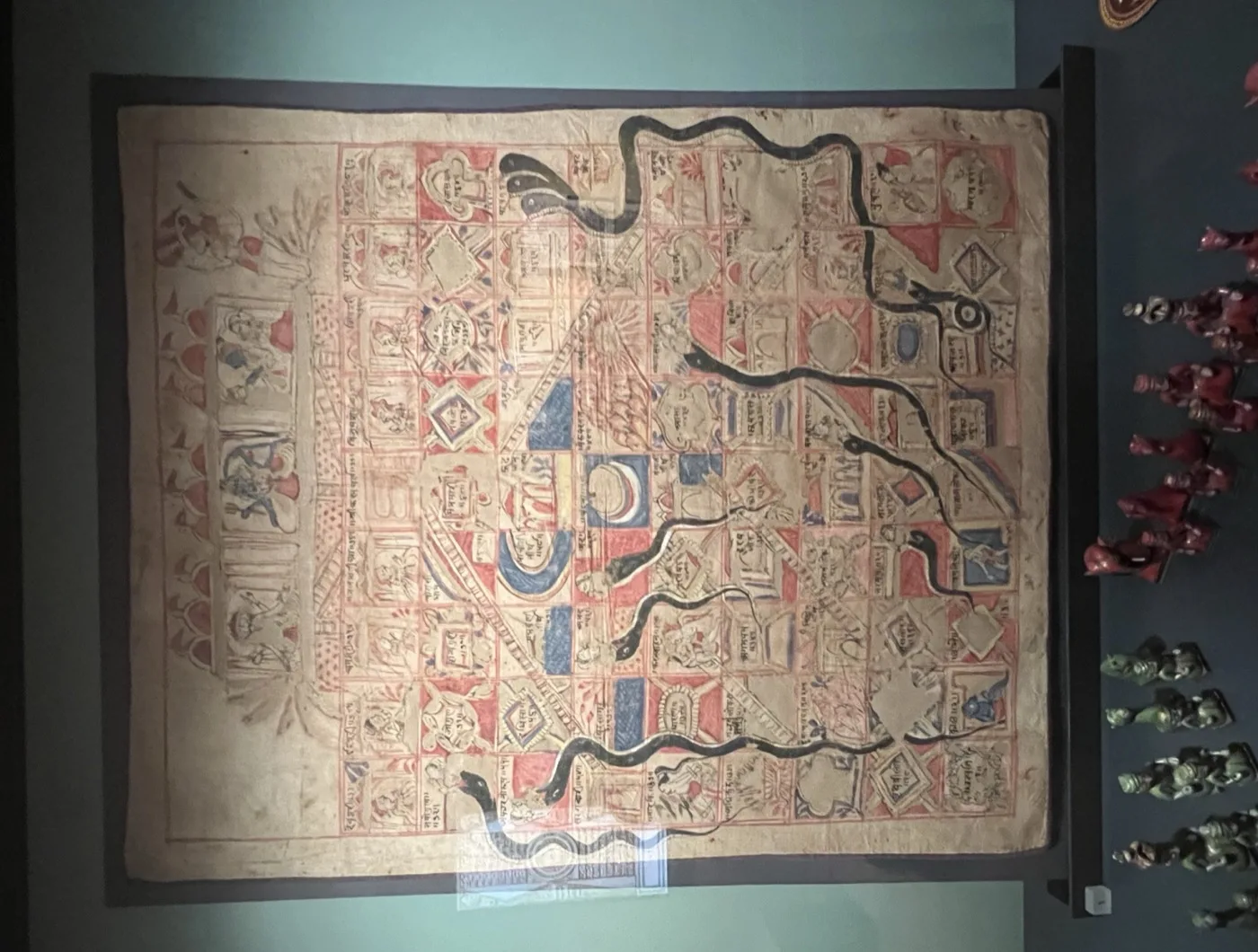
There is a related Bengali game called golok dham, played on 64 squares toward the heaven of Krishna. It appears in a list of objects collected for the museum at the Indian Institute in Oxford in 1884, where it is described as “lately invented”. The same year, the gospel of Ramakrishna records him watching his followers play it on 29 September, and quotes him on 2 October: “In the game of golakdham one may advance a great deal, but still somehow one’s piece may fail to reach the goal.”
So in 1884 a game of this family could still be new, and people around it knew that it was new. Games of this kind were being invented within living memory of the people who wrote about them. That is a useful thing to hold in mind when a board of unknown provenance is said to be a thousand years old.
Why any of this matters, including to us
We run an online version of the 72-square board, so we have an obvious interest in the game sounding venerable, and for a while our own pages said “ancient” without thinking about it. We took the word out once we had read the sources, because the real story is better than the marketing one.
What the record shows is not a game handed down unchanged from antiquity. It is a teaching device that appears in the late eighteenth century, spreads fast across Vaishnava, Jain, Sufi and Advaita traditions, each adapting the board to its own map of the world, and reaches England in 1892 with the meaning stripped out of it. That happened within about a century. It is a more remarkable thing than a slow two-thousand-year drift, and it has the advantage of being what the objects support.
That is what the objects support.
What they cannot show is what happens on one. In three hundred games we read, the thing people walked in with was hardly ever the question they ended up playing. Finding the real one is most of the evening.
Sources
- Jacob Schmidt-Madsen, The Game of Knowledge: Playing at Spiritual Liberation in 18th- and 19th-Century Western India, PhD thesis, University of Copenhagen, 2019. Open access: vol. 1, vol. 2, appendices. Page numbers above refer to volume 1.
- Andrew Topsfield, “The Indian Game of Snakes and Ladders”, Artibus Asiae 46:3 (1985), pp. 203–26.
- Andrew Topsfield, “Snakes and Ladders in India: Some Further Discoveries”, Artibus Asiae 66:1 (2006), pp. 143–79.
- Swami Nikhilananda (trans.), The Gospel of Sri Ramakrishna, entries for 29 September and 2 October 1884.
Quotations are given verbatim. I have read Schmidt-Madsen directly; Topsfield’s two articles I know through his citations in it, and I have said so wherever the claim is his. If you find an error here, tell me and I will correct it.