Alexander Krasnobaev
Developer of Leela Online · writes the guide on this site · last updated October 14, 2026
I build Leela Online — a browser adaptation of the classical 72-square Gyan Chauper board with an AI guide who leads the session one-on-one. Everything in the guide section is written by me.
Where my knowledge comes from
Two things, and it's worth being clear about which is which.
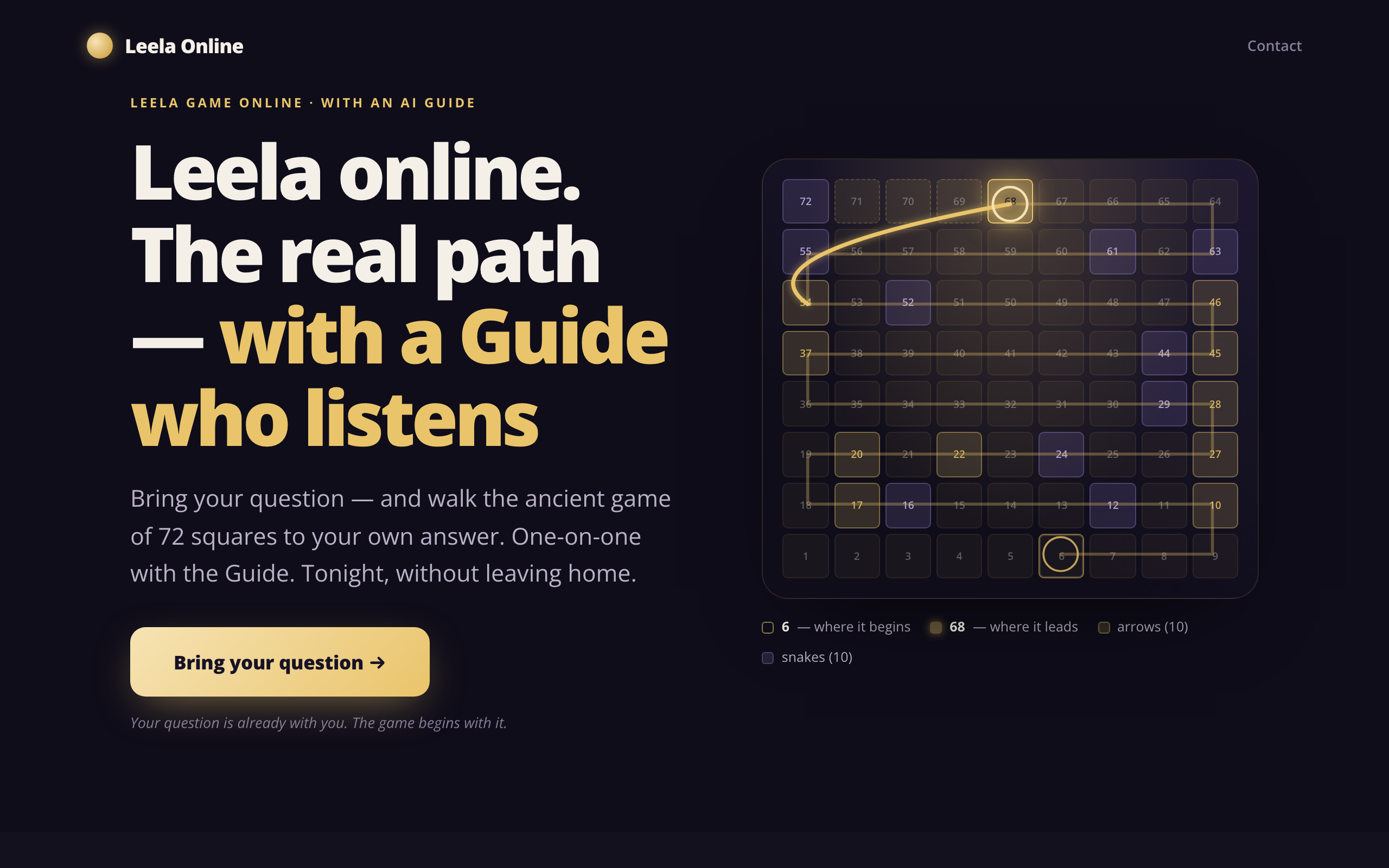
The first is the board itself: the layout, the Sanskrit names of the squares, the ten snakes and ten arrows, the way the path resolves. That comes from Harish Johari's Leela: The Game of Self-Knowledge (1975), from surviving boards documented in museum collections, and from the scholarship on Gyan Chauper — I read it because I had to implement the thing, and implementation is unforgiving about details a description can leave vague.
The second is playing it. I walked the board myself long before I wrote a line of code, and I still play — several times a year, with a real question each time. Twice it took me somewhere I had been circling for years and had never once said out loud, which is a strange thing to get from a die and a 72-square board. That is the honest reason this version exists: not a market gap, but an evening that did something for me and that I could not book on demand.
Playing it repeatedly is also the only way to design the guide. You learn which squares land hardest, where the path stalls, and how easily a question drifts — from the inside, on your own material. Players' own words stay private: nothing anyone writes in a session is quoted or published. What I study across other people's games is anonymised and aggregate — which themes people bring, and where a question tends to change on the way — never whose question it was. Since September 2025 the platform has hosted more than 2,000 games in three languages, and in over 950 of them the game accepted a formulated question.
- 2,000+ games on the platform since September 2025 (Russian, English, Spanish); 950+ with a formulated question.
- Across accepted questions, the anonymous tally runs 28% work and calling, 28% relationships, 18% money, 17% state of being — and self-worth is what surfaces underneath most of them.
- The path completes only on an exact landing on square 68.
Published work
“Gyan Chaupar: The Dated Charts and the Game Today” — Global InCH, International Journal of Living Heritage (ISSN 2581-9410), October 2026. Part one sets out what the dated charts and the earliest references actually show, following the work of Andrew Topsfield and Jacob Schmidt-Madsen, and traces the widely repeated English date of 1892 to its source. Part two describes how the game is played today, from aggregate records only. The full text is available to the journal's subscribers; my contributor page is open.
What I'm not
I'm not a psychologist, a therapist, or a scholar of Indian religion. Where the guide touches those fields it stays close to what's documented and says when something is uncertain — for example, I currently have an open question about which traditional rules are actually documented, because the sources contradict each other and I'd rather show that than smooth it over.
The game itself doesn't diagnose or treat anything. It's a structure for one honest question and an evening of attention.
Elsewhere
- Global InCH — contributor page at the International Journal of Living Heritage
- ORCID — research profile, 0009-0001-6805-0974
- Quora — answers about self-knowledge, people-pleasing, and the game
- Board & Card Games Stack Exchange — questions about historical board game rules
- BoardGameGeek — the entry for the original Leela board, where Leela Online is listed as a web link
Contact
Press assets and screenshots: screenshots and icon. For anything else — a correction to the guide, a research question about the data, a review copy of the full game — write via the contact page. Corrections are genuinely welcome; several details in the guide exist because someone pushed back.

The guide is the theory. The board is the practice.
Bring the question you have been circling. Most people find the one they meant is not the one they arrived with.